If you’ve spent any time using Ethereum, you’ve probably noticed something frustrating: the network can become expensive when lots of people are using it at the same time.
I remember the first time I tried to understand why a relatively small blockchain transaction could cost more than expected. At first, I thought the problem was simply the wallet I was using.
It wasn’t.
The bigger issue was network demand and scalability.
As more people started using blockchain applications, developers needed ways to process more transactions without requiring every transaction to be handled directly by the main blockchain in exactly the same way.
That’s where the terms Layer 1 and Layer 2 become important.
Ethereum is a Layer 1 blockchain. Networks and scaling systems such as Arbitrum operate as Layer 2 solutions designed to work with Ethereum’s ecosystem and improve transaction scalability.
Polygon is a little more complicated because “Polygon” refers to a broader family of scaling technologies and networks. Some Polygon networks use different architectures and should not simply be treated as identical to Arbitrum.
For a beginner, this distinction matters.
In this guide, we’ll break down what Layer 1 and Layer 2 mean, why Layer 2 networks exist, how Arbitrum works, how Polygon fits into the scaling landscape, what happens when you bridge assets, and what mistakes to avoid when moving crypto between networks.
What Is a Layer 1 Blockchain?
A Layer 1 blockchain is a base blockchain network that maintains its own consensus and settlement system.
Examples include:
- Bitcoin
- Ethereum
- Solana
- Avalanche
These networks have their own protocols, validators or miners, native assets, and transaction rules.
Ethereum is particularly important when discussing Layer 2 because many Layer 2 systems are designed to use Ethereum for some combination of settlement, security, and data availability.
You can think of Layer 1 as the underlying foundation.
What Is a Layer 2 Blockchain?
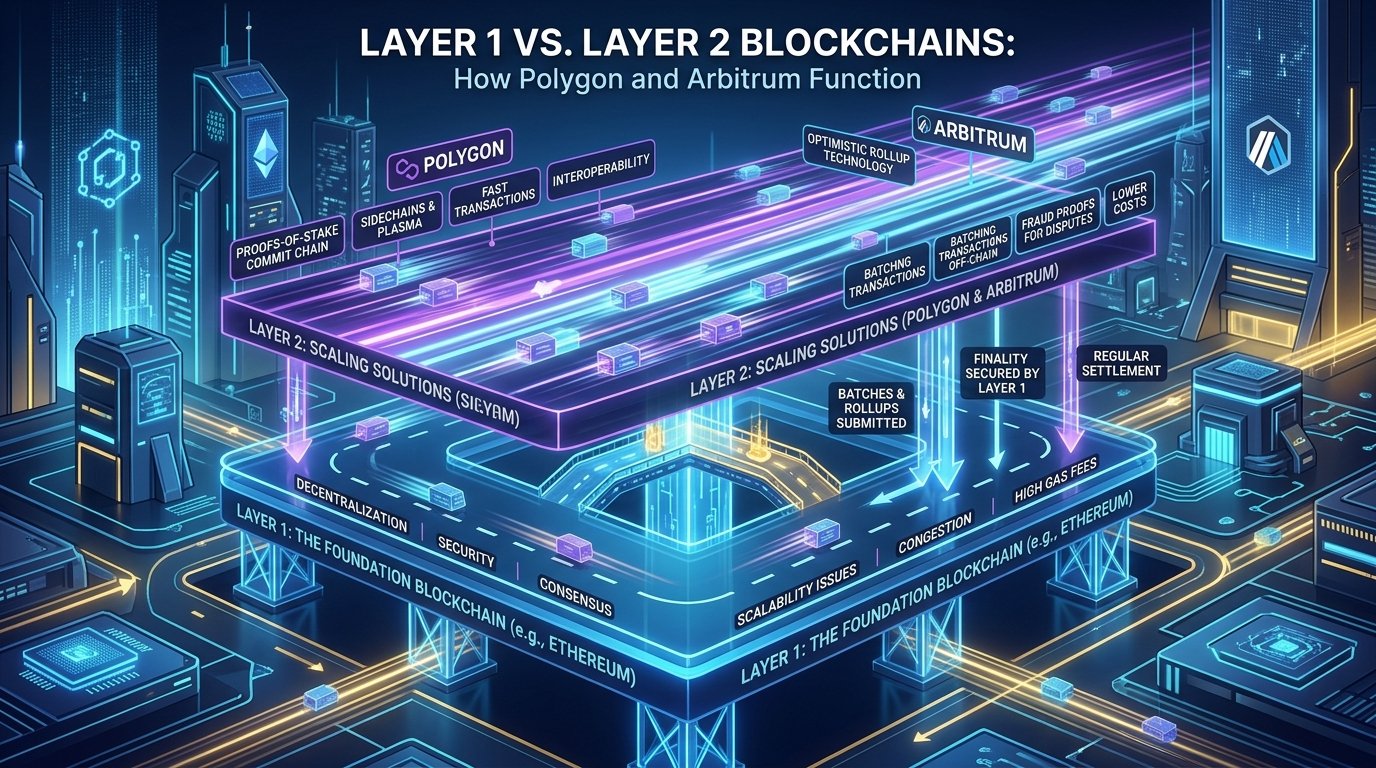
A Layer 2 is a system built on top of, or closely connected to, a Layer 1 blockchain to improve scalability or transaction efficiency.
The basic idea is:
Layer 1 = base settlement layer
Layer 2 = additional execution/scaling layer
Instead of forcing every user operation to happen directly on the Layer 1, a Layer 2 can process transactions using its own execution environment and then interact with the underlying Layer 1 according to its design.
The exact mechanism varies between Layer 2 systems.
Why Do We Need Layer 2 Networks?
Imagine a busy road.
If every car has to use one small road, traffic eventually becomes a problem.
One solution is to build additional roads that connect back to the main transportation network.
Blockchain scaling has a similar concept.
If a Layer 1 becomes heavily used, transaction costs can rise and users may experience congestion.
Layer 2 systems attempt to increase usable transaction capacity while maintaining a connection to the underlying blockchain.
This can make certain applications more practical for everyday users.
Layer 1 vs. Layer 2: Simple Comparison
| Feature | Layer 1 | Layer 2 |
|---|---|---|
| Role | Base blockchain | Scaling layer |
| Own Consensus | Yes | Usually relies partly on underlying Layer 1 |
| Examples | Ethereum, Bitcoin, Solana | Arbitrum, Optimism, Base |
| Main Goal | Security, settlement, execution | Scalability and lower-cost execution |
| Transaction Fees | Can be higher during congestion | Often lower for supported activities |
| Relationship | Independent base network | Connected to a Layer 1 |
This is a simplified comparison because different Layer 2 architectures work differently.
Ethereum as a Layer 1
Ethereum is one of the most important Layer 1 networks in the blockchain ecosystem.
It provides:
- Consensus
- Settlement
- Smart-contract execution
- Data infrastructure
- Native ETH
- A large developer ecosystem
However, running every application operation directly on Ethereum can become expensive when demand is high.
That’s one reason Layer 2 networks have become so important.
What Is Arbitrum?
Arbitrum is a scaling ecosystem designed around Ethereum.
One of its major technologies is Arbitrum Rollup, which uses optimistic-rollup architecture.
The basic idea is to execute many transactions outside Ethereum’s main execution environment and then post relevant information to Ethereum.
This can reduce the amount of computation that needs to happen directly on Ethereum for each individual user operation.
How Arbitrum Works
The technical details are complicated, but the basic process can be understood step by step.
Step 1: You Submit a Transaction
Suppose you’re using a decentralized exchange through your wallet.
Instead of sending the transaction directly to Ethereum mainnet, you select Arbitrum as the network.
Your wallet sends the transaction to the Arbitrum system.
Step 2: Arbitrum Processes Transactions
Transactions can be executed within Arbitrum’s environment.
Multiple transactions can be processed together rather than requiring each user operation to be handled independently on Ethereum’s main execution layer.
Step 3: Transaction Data Is Posted to Ethereum
Arbitrum uses Ethereum as an important part of its security and settlement architecture.
Relevant transaction information is ultimately committed to Ethereum according to the rollup’s design.
Step 4: Fraud-Proof Mechanisms Help Resolve Disputes
Arbitrum’s optimistic-rollup design assumes submitted results are correct unless challenged under the protocol’s dispute process.
If an invalid result is challenged, the system can use fraud-proof mechanisms to determine the correct result.
This is one of the fundamental differences between optimistic rollups and other scaling approaches.
Why Is It Called an Optimistic Rollup?
The term “optimistic” refers to the assumption that submitted transaction results are valid unless someone successfully challenges them.
Instead of having Ethereum independently execute every transaction from scratch, the Layer 2 system can process transactions and provide mechanisms for detecting incorrect claims.
This allows the system to move more activity away from direct Layer 1 execution.
What Is Polygon?
Polygon is a blockchain scaling ecosystem associated closely with Ethereum.
However, it’s important not to think of “Polygon” as one single technology.
The Polygon ecosystem has included multiple networks and technologies, including Polygon PoS and newer zero-knowledge-based scaling efforts.
For a beginner, this distinction can be confusing because you may simply see “Polygon” listed in a wallet or application.
The specific Polygon network you’re using matters.
Polygon PoS
Polygon PoS is an Ethereum-compatible sidechain-style network that uses its own validator set and consensus architecture.
It has been widely used for:
- DeFi applications
- Token transfers
- NFTs
- Gaming
- Web3 applications
Because it has its own validator infrastructure, it is technically different from an Ethereum rollup such as Arbitrum.
This is an important distinction.
You shouldn’t automatically assume that every network marketed as an Ethereum scaling solution has the same security model.
Polygon’s Zero-Knowledge Approach
Polygon has also invested heavily in zero-knowledge (ZK) technology.
ZK-based scaling systems can allow one party to prove that a set of computations was performed correctly without requiring the underlying Layer 1 to execute every individual computation itself.
This is a rapidly developing area of blockchain technology.
For ordinary users, the practical result can be improved scalability and potentially lower transaction costs, depending on the network and application.
Arbitrum vs. Polygon
The comparison isn’t always straightforward because Polygon includes multiple technologies.
But if you’re comparing Arbitrum with Polygon PoS, some basic differences are useful.
| Feature | Arbitrum | Polygon PoS |
|---|---|---|
| General Type | Ethereum Layer 2 rollup | Ethereum-compatible sidechain |
| Relationship With Ethereum | Strong settlement/security relationship | Separate validator infrastructure |
| Main Technology | Optimistic rollup | PoS-based sidechain architecture |
| EVM Compatibility | Yes | Yes |
| Lower Fees Than Ethereum Mainnet | Generally | Generally |
| Smart Contracts | Yes | Yes |
| Native Asset | ETH is used for gas on Arbitrum | POL/MATIC ecosystem transition depends on network/version |
| Main Strength | Ethereum-aligned rollup scaling | Low-cost EVM-compatible environment |
Because blockchain architectures change over time, always check the specific network documentation before moving assets.
Why Layer 2 Transactions Can Be Cheaper
The main advantage comes from handling activity more efficiently.
Imagine 1,000 users making transactions.
If every transaction has to be executed independently on Layer 1, the cost can become significant.
A Layer 2 can process many transactions and then interact with Layer 1 in a more compressed or efficient manner, depending on the architecture.
The exact savings vary.
They depend on:
- Network demand
- Data costs
- Transaction type
- Layer 2 architecture
- Ethereum fees
- Application design
So don’t assume that Layer 2 transactions will always cost the same amount.
What Are Rollups?
A rollup is a scaling technology that executes transactions outside the main Layer 1 execution environment and then publishes data or proofs back to the Layer 1.
Two major categories are:
Optimistic Rollups
Examples include Arbitrum and Optimism.
They generally assume submitted transaction results are valid unless challenged.
Zero-Knowledge Rollups
These use cryptographic proofs to demonstrate that transactions were processed correctly.
Many projects, including parts of the Polygon ecosystem, have invested heavily in ZK technology.
The approaches are different, but both aim to improve blockchain scalability.
What Is a Blockchain Bridge?
A bridge is a system that allows assets or information to move between blockchain networks.
For example, you might have ETH on Ethereum mainnet and want to use an application on Arbitrum.
You may need to move your assets through a bridge or use an exchange or another supported transfer mechanism.
This process can be confusing for beginners.
A Simplified Bridge Process
- Connect your wallet.
- Select the source network.
- Select the destination network.
- Select the asset.
- Enter the amount.
- Review fees and transaction details.
- Confirm the transaction.
- Wait for the required processing.
- Check the destination network.
Never rush through this process.
Why Bridges Need Extra Caution
Bridges have historically been an important security concern in the blockchain ecosystem.
A bridge can involve smart contracts, validators, external infrastructure, or other mechanisms.
If a bridge has a vulnerability, users can potentially lose assets.
That’s why you should use established bridge infrastructure and verify that you’re interacting with the correct official application.
A Common Beginner Mistake: Wrong Network
This is probably one of the most important things to understand.
Suppose someone gives you an address and tells you to send ETH.
You shouldn’t immediately send it.
First ask:
Which network?
ETH can be used across multiple networks and representations.
Sending assets using an unsupported network can create complications and, in some situations, result in loss of access to the funds.
Before sending:
- Confirm the network.
- Confirm the asset.
- Confirm the receiving platform supports it.
- Check the wallet address.
- Check the fee.
- Start with a small test transaction when appropriate.
How to Switch Networks in a Wallet
The exact interface depends on your wallet.
In a wallet such as MetaMask, the network selector lets you choose between supported networks.
A simplified process is:
Step 1
Open your wallet.
Step 2
Find the network selector.
Step 3
Choose the network required by the application.
Step 4
Check your balance again.
Don’t panic if the balance appears different after switching networks.
You may simply be viewing a different blockchain.
Why Your Balance Can Look Like It Disappeared
This happens frequently to beginners.
Suppose you have ETH on Ethereum mainnet.
Then you switch your wallet to Arbitrum.
Your Ethereum-mainnet ETH isn’t necessarily gone.
You’re simply looking at another network.
The same wallet address can sometimes exist across multiple EVM-compatible networks, but the assets and balances on each network are separate.
Always check the network before assuming something went wrong.
Layer 1 vs. Layer 2 Fees
One of the main reasons users choose Layer 2 is cost.
But remember:
Lower fees don’t mean zero fees.
You may still pay fees when:
- Moving assets
- Swapping tokens
- Interacting with smart contracts
- Bridging between networks
Sometimes the initial bridge transaction can cost more than expected because you are interacting with Layer 1.
Once your assets are on a Layer 2, subsequent transactions may be cheaper, depending on network conditions.
Are Layer 2 Networks Completely Safe?
No blockchain network should be treated as completely risk-free.
Layer 2 systems can have risks involving:
- Smart contracts
- Bridges
- Sequencers
- Governance
- Centralization
- Software bugs
- User mistakes
The security model also differs from one Layer 2 to another.
That’s why understanding the specific network is more useful than assuming “Layer 2 = safe.”
Common Layer 2 Mistakes
Mistake #1: Choosing a Network Just Because Fees Are Cheap
Low fees are useful, but compatibility matters more.
Mistake #2: Using Random Bridges
Don’t use an unknown bridge simply because someone posted a link on social media.
Mistake #3: Forgetting to Keep Gas on the Destination Network
If you move tokens to another network, you may need that network’s gas token to make future transactions.
Mistake #4: Confusing Polygon Networks
“Polygon” can refer to different technologies and networks.
Check the exact network.
Mistake #5: Sending Everything at Once
When using a new network for the first time, a small test transfer can be a sensible precaution.
When Should You Use Layer 1?
Ethereum mainnet may make sense when:
- You need Ethereum’s base-layer environment
- An application only supports mainnet
- You’re performing a transaction where Layer 1 settlement is important to your use case
- You understand and accept the current fees
Layer 1 isn’t “bad” simply because it’s more expensive.
It provides the underlying security and settlement infrastructure that many Layer 2 systems depend on.
When Should You Use Layer 2?
Layer 2 may make sense when:
- The application supports it
- You want lower transaction costs
- You’re making frequent transactions
- You’re interacting with DeFi applications
- You want to reduce exposure to Ethereum mainnet fees
Again, compatibility should come before cost.
A Practical Example
Imagine you have ETH on Ethereum and want to use a decentralized application that supports Arbitrum.
A simplified process might look like:
Ethereum → Bridge/Transfer → Arbitrum → Use dApp
Instead of paying Ethereum mainnet fees for every subsequent interaction, you can perform supported transactions on Arbitrum.
When you’re finished, you may move assets back to Ethereum or another supported destination.
The exact cost and processing time will depend on the bridge, networks, and current conditions.
How to Choose Between Polygon and Arbitrum
Don’t choose based only on which name appears more popular.
Ask these questions:
1. Which network does the application support?
This should be your first question.
2. What asset do you have?
Make sure the asset is supported on the destination network.
3. What are the current fees?
Check before making the transaction.
4. What security model does the network use?
Understand whether you’re dealing with a rollup, sidechain, or another architecture.
5. Do you need a bridge?
If so, research the bridge before using it.
6. Do you have gas for the destination network?
You may need the network’s gas token to perform future transactions.
The Bigger Picture: Blockchain Scaling
Layer 1 and Layer 2 aren’t really competitors in the way beginners sometimes imagine.
They can work together.
Ethereum can provide a base settlement and security layer, while Layer 2 systems process additional activity.
The long-term goal is to allow blockchain applications to handle more users without forcing every transaction to compete for limited Layer 1 block space.
Different projects are experimenting with different solutions.
Some use optimistic rollups.
Others use zero-knowledge proofs.
Some operate sidechains or other scaling architectures.
The technology is still evolving.
Final Thoughts
The easiest way to understand Layer 1 and Layer 2 is to think about their roles.
A Layer 1 is the base blockchain.
A Layer 2 is an additional scaling system designed to process activity more efficiently while maintaining a relationship with the underlying Layer 1.
Arbitrum is a prominent Ethereum scaling solution based on optimistic-rollup technology. Polygon, meanwhile, represents a broader ecosystem containing different approaches, including Polygon PoS and zero-knowledge-based technologies.
For everyday users, the biggest practical benefit of these networks can be lower transaction costs and access to applications without relying entirely on Ethereum mainnet for every operation.
But lower fees shouldn’t make you careless.
The biggest mistakes usually happen when someone selects the wrong network, uses an unverified bridge, or assumes that all versions of a token are interchangeable.
When moving crypto between Ethereum, Arbitrum, Polygon, or another network, take an extra minute to check the network, asset, destination, fees, and bridge you’re using.
That small habit can make using Layer 2 networks much less intimidating—and potentially save you from a very expensive mistake.